
Summary:EV charger installations
There are three types of EV chargers. Level 1 uses your standard home outlet and adds 4 to 5 miles per hour. No installation needed. Level 2 uses a 240V circuit (like your dryer) and adds 15 to 40 miles per hour. Requires a licensed electrician and possibly a panel upgrade. Level 3 is the ultra-fast highway charger that adds 100 to 300 miles in 30 minutes. Not practical or necessary for home use.
The one question that decides everything: How many miles do you drive per day? Under 30 miles, Level 1 may be enough. Over 30 miles, Level 2 is the right investment. Level 3 is already out there on the highway when you need it.
You just got your EV. Congratulations. Now your neighbor asks, “Do you have a home charger set up?” And you realize you have no idea what that means.
- Do you need to buy something?
- Install something?
- Call someone?
- Or just plug the car into the wall and call it a day?
This guide answers all of that. Here we will give a clear breakdown of the three types of EV chargers, what each one actually feels like to use, and which one makes sense for your home and your commute.
What Are the Types of EV Chargers? (The 30-Second Version)
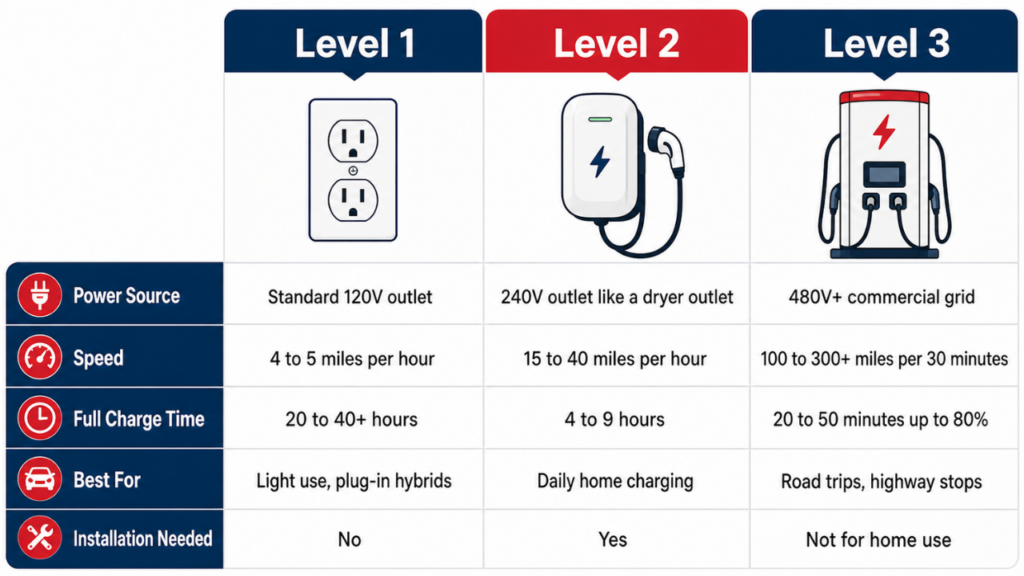
There are three levels of EV chargers. Think of them like water flow.
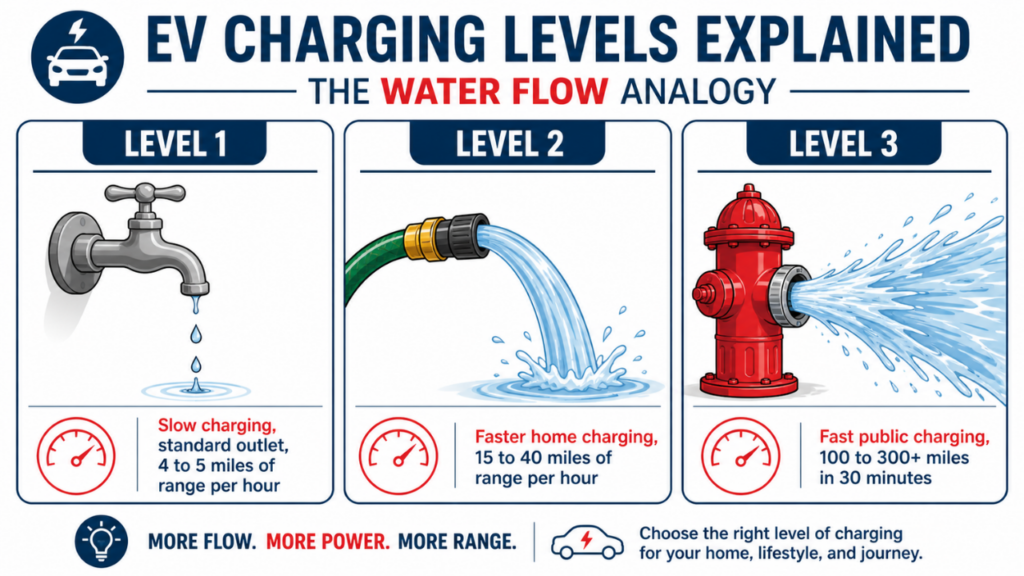
- Level 1 is a slow drip.
- Level 2 is a garden hose.
- Level 3 is a fire hydrant.
Here is how they compare at a glance:
| Feature | Level 1 | Level 2 | Level 3 |
| Power Source | Standard 120V outlet | 240V outlet (like a dryer) | 480V+commercial grid |
| Speed | 4 to 5 miles per hour | 15 to 40 miles per hour | 100 to 300+ miles per 30 min |
| Full Charge Time | 20 to 40+ hours | 4 to 9 hours | 20 to 50 minutes (up to 80%) |
| Best For | Light use, plug-in hybrids | Daily home charging | Road trips, highway stops |
| Installation Needed? | No | Yes | Not for home use |
What Is a Level 1 Charger?
A level 1 charger uses the same standard three-prong outlet you plug your lamp into. Most EVs come with a portable Level 1 cord in the trunk. This cord uses the J1772 connector (also called the J-plug), which is the North American standard for AC home charging.
You pull it out, plug one end into the car and the other into the wall, and charging begins.
No special setup. No electrician. No cost beyond what you paid for the car.
One thing worth knowing: some newer EV models, including certain Kia and Hyundai vehicles, no longer include a Level 1 cord in the box. If yours did not come with one, a replacement cord costs around $150 to $200.
How Fast Does It Actually Charge?
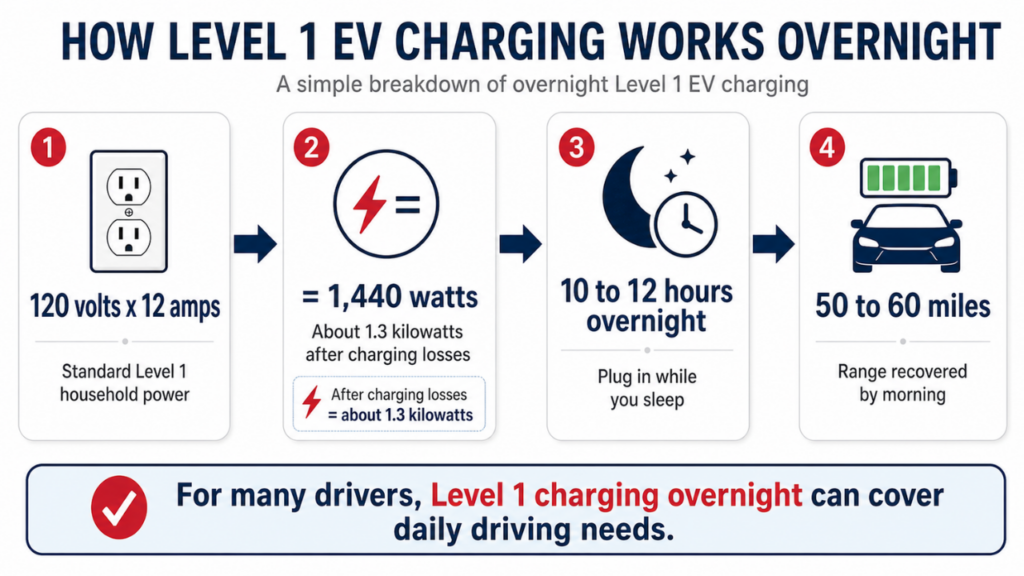
You will see that Level 1 only delivers 2 to 3 miles of range per hour. That figure is misleading.
Here is how the real math works. A standard Level 1 charger runs at 12 amps and 120 volts. That is 1,440 watts of power, or roughly 1.3 kilowatts after accounting for normal charging losses. Multiply that by your car’s efficiency, and most modern EVs add 4 to 5 miles of range per hour on Level 1.
Plug in for 10 to 12 hours overnight, and you recover 50 to 60 miles of range. For most drivers, that is more than enough.
Who Should Actually Use Level 1?
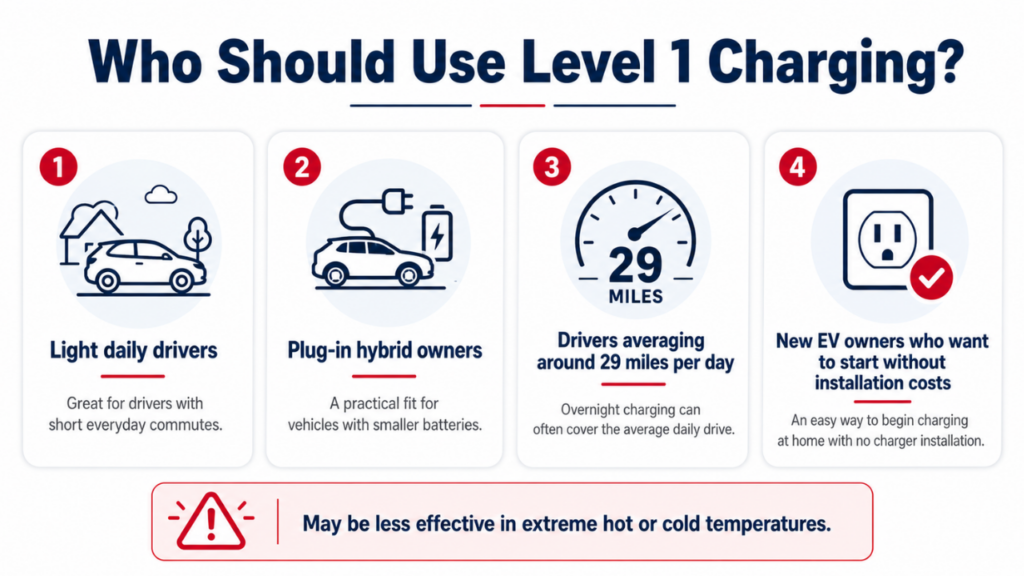
According to the U.S. Department of Transportation, the average American drives about 29 miles per day.
If your daily driving is around this range, Level 1 overnight charging can comfortably cover your needs without any additional setup or cost.
Level 1 works well for plug-in hybrid owners, light daily drivers, and anyone who wants to try EV ownership without committing to an installation right away. You can always upgrade later if you find it is not keeping up.
Where Level 1 Falls Short
Level 1 charging can slow down in very hot or very cold weather. The battery uses extra energy to stay at a safe temperature, so less power goes into charging. Because of this, charging speed can drop to about 2–3 miles of range per hour. You might even wake up with less charge than you expected.
In places like Orange County and the Los Angeles area, the weather is usually mild, so this is not a big issue. But it can matter if you travel to colder areas or charge during a heat wave.
What Is a Level 2 Home Charger?
A level 2 home charger runs on a 240V circuit. That is the same type of outlet used by your electric dryer or oven. It delivers significantly more power to your car, which means much faster charging.
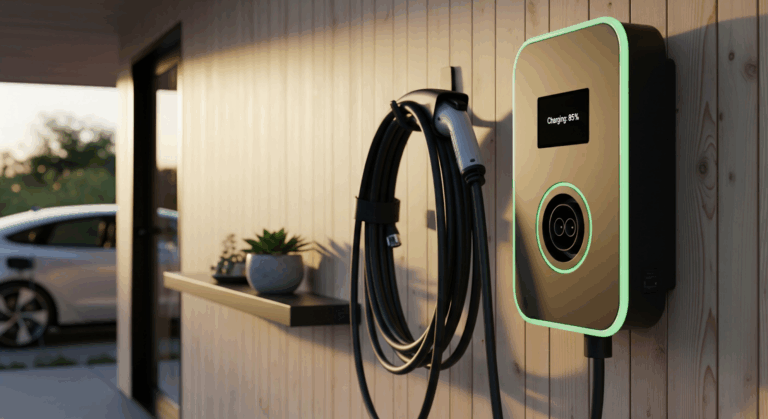
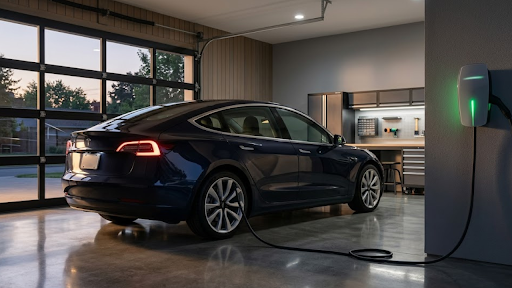
Most homeowners install a dedicated wall unit in their garage or near their driveway. You plug in when you get home, and by morning, your car is full. That is the whole system.
How Fast Does Level 2 Charging Actually Feel?
At a typical 32-amp Level 2 setup, you are drawing around 7.6 kilowatts of power. That translates to 15 to 40 miles of range added per hour, depending on your vehicle. A common mid-size EV with a 60 to 70 kilowatt-hour battery charges from empty to full in roughly 8 to 9 hours.
What Does Level 2 Installation Actually Involve?
A Level 2 home charger requires a dedicated 240V circuit. A licensed electrician runs new wiring from your electrical panel to the charger location, typically in the garage. They pull the necessary permits and make sure the installation meets local code requirements.
Here is what you need to know: your existing electrical panel may need an upgrade before any of that happens. Panel upgrades are often the biggest cost factor. You can see real price ranges in our EV charger installation cost guide.
Older homes in Orange County and the greater Los Angeles area were not designed with EV charging in mind. If your panel is already close to capacity, adding a 240V circuit without upgrading it first can cause:
- Tripped breakers
- Overheating
- Fire risk
A qualified electrician checks your panel before anything else. If an upgrade is needed, it gets handled as part of the same project. At Renewed Electric, we assess your panel during the free estimate visit. There are no surprises when work begins.
What Is a Level 3 Charger?
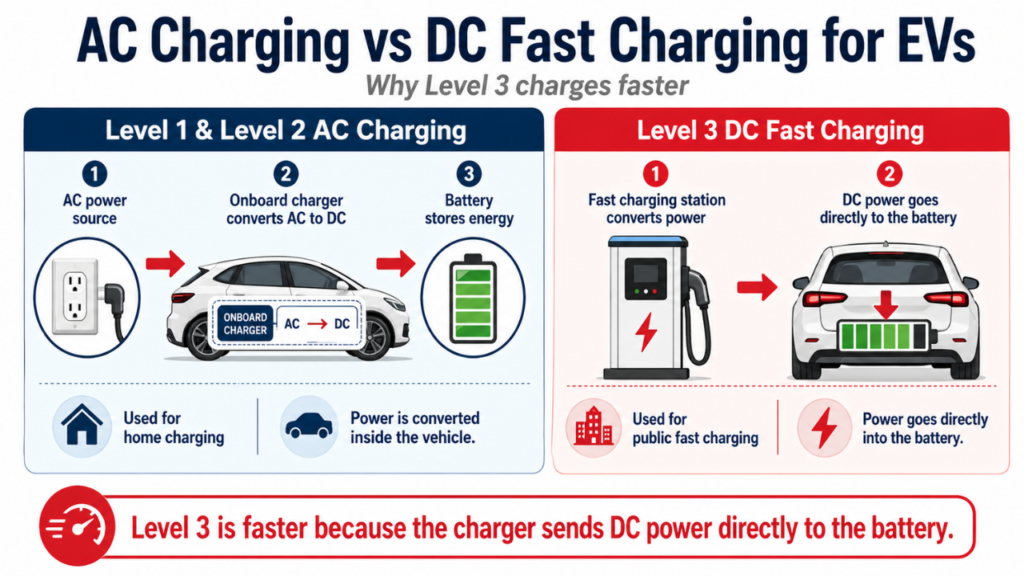
Level 3 chargers are also called DC Fast Chargers. They are the ultra-fast stations you find on:
- Highways
- At shopping centers
- Near major transit routes
They operate at 480 volts or higher and use direct current instead of the alternating current that Level 1 and Level 2 deliver.
That distinction matters. With Level 1 and Level 2, your car’s internal onboard charger converts AC power to DC before storing it in the battery. Level 3 skips that step entirely. The station performs the conversion itself and pushes DC power directly into the battery pack. That is what makes it so fast.
Most Level 3 stations in the United States now use either:
- CCS1 (Combined Charging System): The plug that combines AC and DC charging in one port, or
- NACS (North American Charging Standard): It was originally developed by Tesla and is now adopted by Ford, GM, Rivian, and Honda.
If you vehicle uses an older CHAdeMO port, confirm compatibility before relying on a fast charging network.
The Real Difference Between Level 2 and Level 3 EV Charging
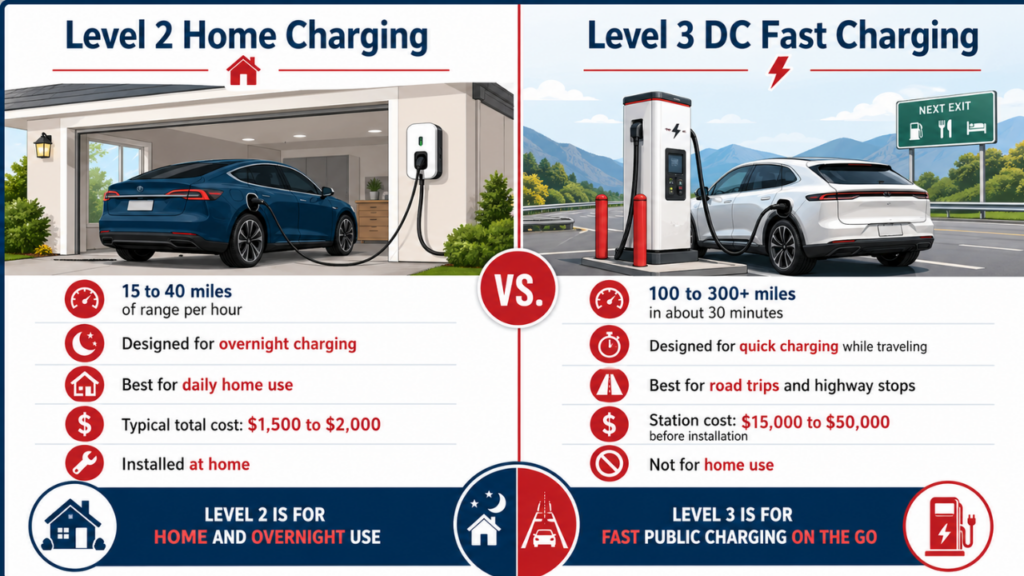
The difference between Level 2 and Level 3 EV charging is simple:
- Level 2 is a daily home tool
- Level 3 is a road trip resource
At a Level 2 home charger, you recover 15 to 40 miles per hour. The Level 2 home charger is designed for overnight charging, where speed is not the priority.
On the other hand, at a Level 3 station, you can add 100 to 300 miles of range in around 30 minutes.
That is designed for drivers who are actively traveling and cannot afford to wait overnight.
The cost gap reflects that difference.
A Level 2 home setup usually costs $1,500 to $2,000. This is the total cost for most homes.
A single Level 3 station is much more expensive. It can cost $15,000 to $50,000. This price is before installation.
Because of this, Level 3 chargers are not used at home. They are built by utility companies. They are also built by retail chains and highway operators.
Which EV Charger Level Do You Actually Need?
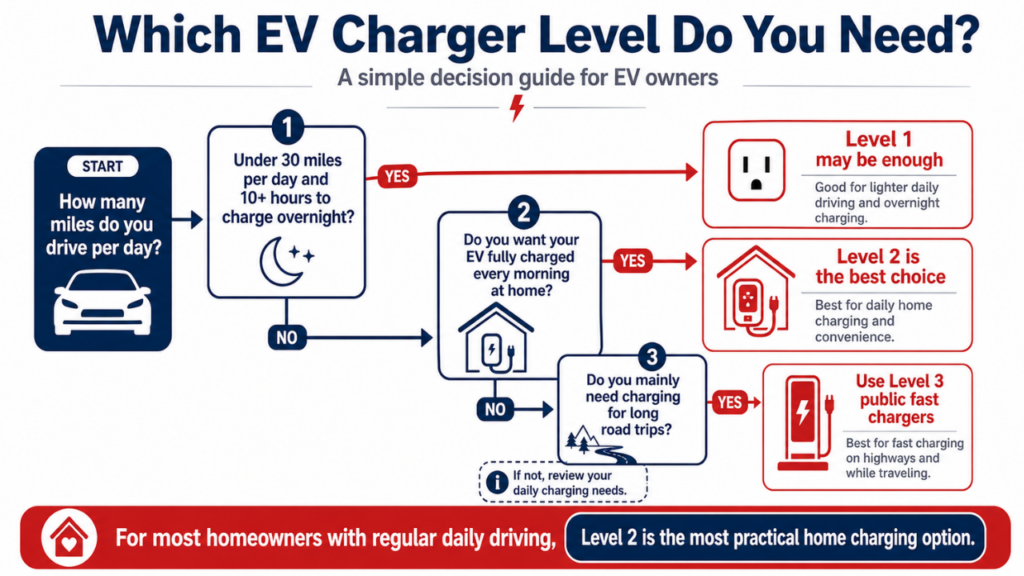
Start with one question: how many miles do you drive per day?
Under 30 miles per day with 10 or more hours to charge overnight: Level 1 may be all you need right now. Try the cord that came with your car first. If it keeps up with your driving, you have saved yourself an installation cost entirely.
Over 30 miles per day, or you want the car fully charged every single morning without thinking about it: Level 2 is the right move. Most EV owners in Southern California land here. One overnight charge, every night, no math required.
Long highway trips: Level 3 stations handle this. Apps like PlugShare and your car’s built-in navigation will route you to them automatically. You do not need one at home.
Ready to Install a Level 2 Charger at Your Home?
The charger decision is the easy part. The part that requires real expertise is understanding what your home’s electrical system can support, whether your panel needs an upgrade, and how to make sure everything is permitted and code-compliant.
That is exactly what we handle at Renewed Electric.
We are a fully licensed electrical contractor (CSLB #1125941) serving Orange County, South LA, North San Diego, West San Bernardino, and West Riverside. Our team has been doing EV charger installations and panel upgrades for over 20 years. We pull all necessary permits, handle the full installation, and walk you through every step before work begins.
Call us or fill out our contact form to schedule a free estimate. We will tell you exactly what your home needs and what it will cost, before you commit to anything.
Frequently Asked Questions
1. Does Level 2 charging hurt your battery?
No. Both Level 1 and Level 2 use alternating current. Your car converts this power inside the battery system. The speed difference does not harm the battery. Studies show no real difference in battery health over time between Level 1 and Level 2 charging at home.
Level 3 charging is different. It uses direct current and much higher power. It also bypasses the car’s internal converter. Frequent use of Level 3 charging can affect battery health over time.
2. Is it cheaper to charge an EV on Level 1 or Level 2?
Level 2 is usually cheaper than Level 1 over time. Level 2 wastes less energy as heat. Level 1 takes longer and loses more energy during charging. You still pay for that wasted electricity. Level 2 also charges faster. This helps you finish charging during off-peak hours. Many utilities in California have lower rates at night between midnight and 6 am.
Level 1 can keep charging into more expensive daytime hours. Level 2 usually finishes before that. Over many years, the savings can be more than $2,000 for average drivers.
3. What is the 80% rule for EV charging?
V batteries charge faster up to about 80 per cent. After 80 percent, the charging becomes much slower. This is normal. It is designed to protect the battery from heat and damage.
This matters most at Level 3 fast chargers. At this point, the charging speed drops a lot.
On road trips, many drivers stop charging at 80 percent. They keep driving instead of waiting for the last 20 per cent. The last part takes almost as long as the first part.
4. What is the difference between Level 2 and Level 3 EV charging?
The main difference is how the power is delivered. Level 2 uses AC power. Your car changes it into battery power inside the car. This is slower and meant for home charging. Level 3 uses DC power. It sends power directly to the battery. It does not need the car to convert it. Because of this, Level 3 is much faster. It can add 100 to 300 miles in about 30 minutes. Level 2 adds about 15 to 40 miles per hour. It is best for daily charging at home. Level 3 is best for quick charging during long trips.
5. Can I install a Level 2 charger myself?
It is not recommended to install a Level 2 charger yourself. In most places, it is not allowed without a licensed electrician. A Level 2 charger needs a 240V circuit. It also needs the right wire size, grounding, and safety protection. A permit is also required. If any of these are done wrong, it can cause fire risk. It will also fail inspection. A licensed electrician does all the work safely. They also check if your electrical panel needs an upgrade first.